Dragon Boat Festival or 端午節/DuānWǔJié is on June 25th, this year (2020), and Tiny Chinese Homeschool is throwing a virtual celebration for you to join in with your family at home. Every week this month, we will release a fun activity or video.
June Week #1: Dragon Boat Festival-themed printables (available now at the bottom of this post).
June Week #2: Zòngzi cooking video and recipe – this is a very ambitious recipe, but it is delicious and an essential part of the holiday.
June Week #3: Shadow puppet tutorial – Shadow puppets were a very traditional way to tell stories in ancient China. Use this tutorial to make a puppet of QūYuán, the person who’s memory we honor in the festival.
June Week #4: The Story of QūYuȧn video premiere! Watch a dramatic shadow puppet video that tells the history behind the Dragon Boat Festival.
We hope you will check back weekly (whether on Facebook or this blog) to celebrate with us!
端午節快樂!
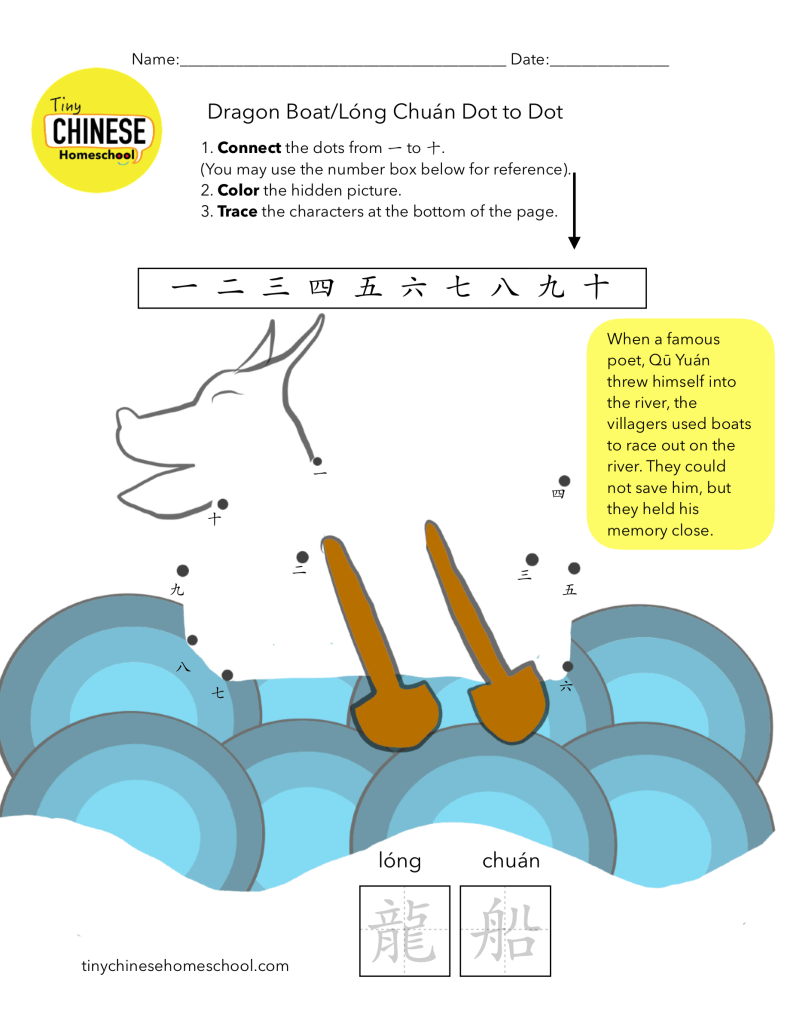
Dragon Boat Festival Printables – Dot to Dot: Not only is this a simple way to introduce two traditions associated with the Dragon Boat Festival, this helps kids practice reading their characters from 1 to 10!
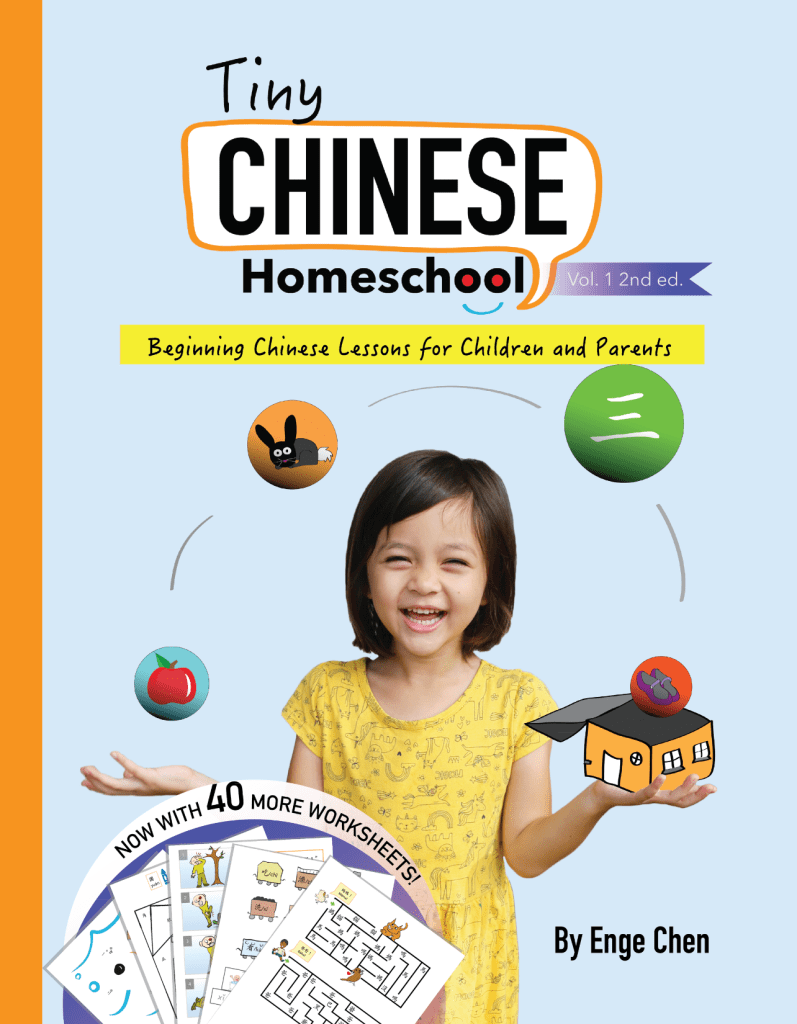
For those of you who have not yet bought the book, now is the time to get it! The 2nd edition of Tiny Chinese Homeschool Vol. 1 has 46 more pages and is on sale for a limited time. For those of you who already have a 1st edition in your hand, check the bottom of this post!
Why make a 2nd edition?
The very first buyers of Tiny Chinese Homeschool Vol. 1 have given me great feedback. Some have said how invaluable the audio has been. Others have complimented the artwork and structure. There was one piece of feedback that really hit a chord with me, and it was from a friend with no previous Chinese experience. She said, “We tried to introduce our child to Chapter 1 today and only got to one page. The material on there is packed!” At the time, I interpreted it as the book being well worth the price because there was so much to learn on one page. As time went on, I’ve thought back and realized the density of information could make it less approachable to new learners and especially young children, the very people this book was made for.
Then, as if I had an itch to scratch, I started making simple worksheets to supplement the lessons already in the workbook. Instead of worksheets that tested both the vocabulary and dialogue phrases, I created mazes and dot-to-dots that simply reestablished one vocabulary word or one phrase. Last year, when I was creating the graphics to the book, I only had access to Illustrator on my computer, so graphic creation was slow. This year, I could create graphics on my tablet so I was able to draw in shorter but more frequent spurts–making it possible for the new worksheets to have original artwork.
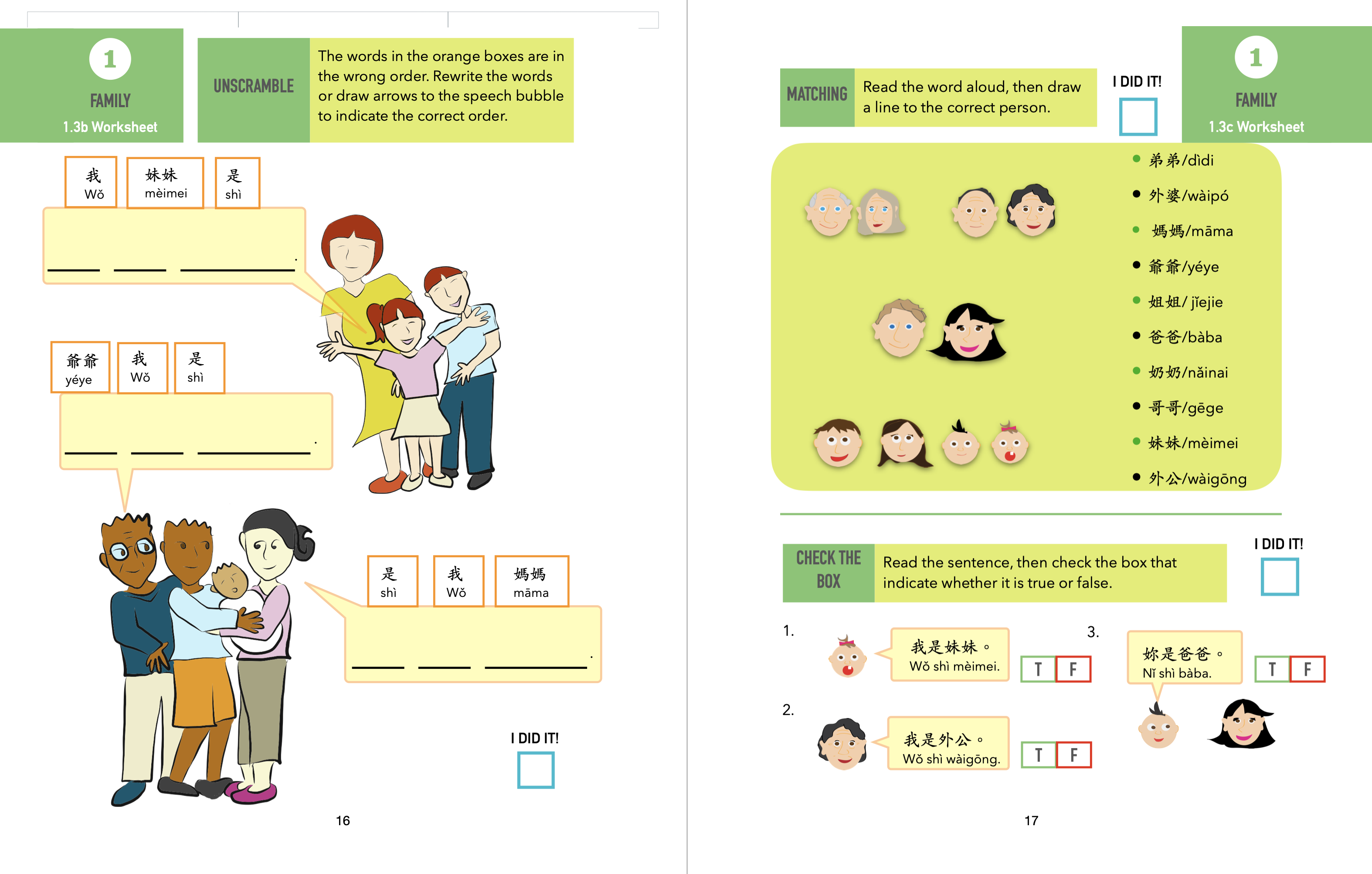
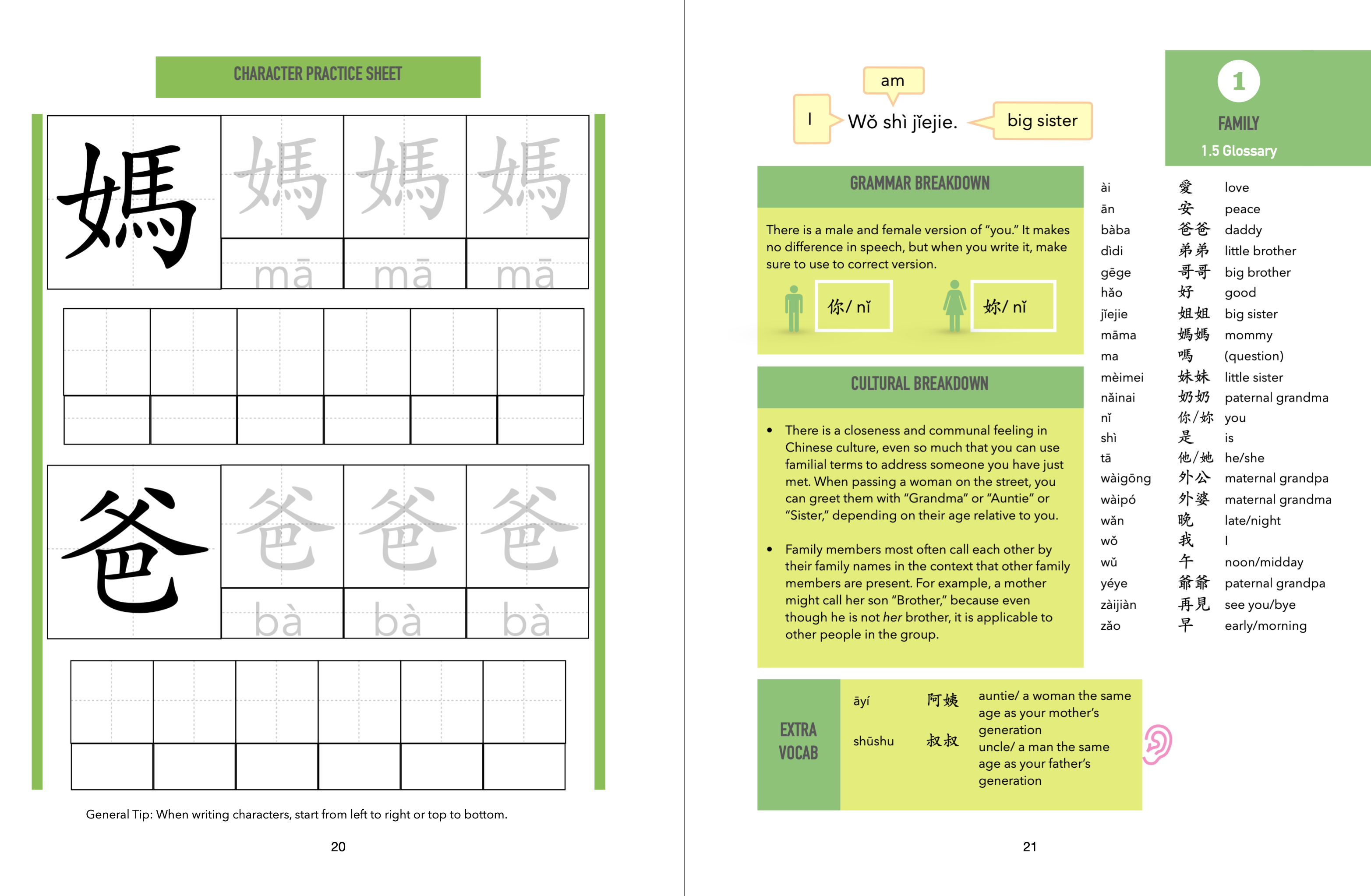
After a couple weeks of feverish activity, I had the new manuscript as it was always meant to be. Please scroll through the first chapter and note some of the changes:
Some of the changes include:
2-3 additional worksheets per chapter
colorful and simple activities for younger children
easier character practice sheets in EVERY chapter with pinyin practice
no additional vocabulary or audio (for easy integration with the previous assets)
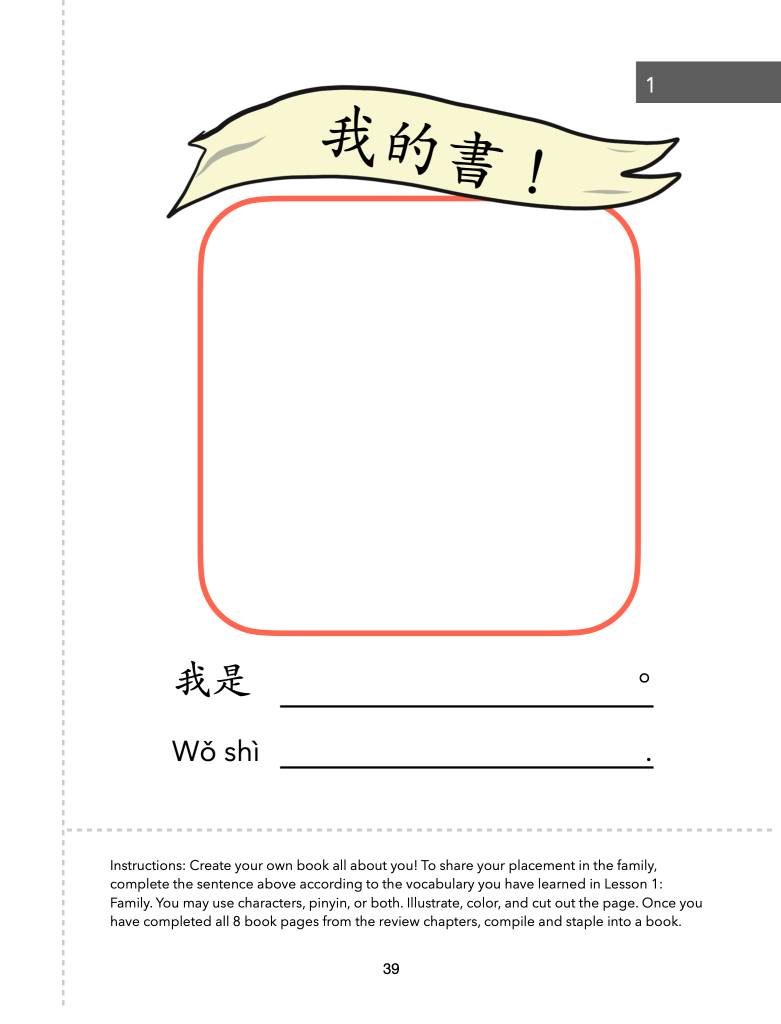
Additionally, the review chapters are expanded to include cut-out pages that you fill in with information about yourself. After you have finished all the review chapters, you will have a book that answers the following questions about yourself: How many people are in your family? How old are you? What do you look like? What do you like to eat?
Originally, the Pinyin Playground had no worksheets because I just assumed the learner could practice on their own. I’ve since added 3 worksheet pages to that chapter to help reinforce pinyin writing and tone writing.
When I submitted the new manuscript for print, I had to raise the price of the book to compensate for the additional printing costs of a thicker volume. To my delight, Amazon has decided to discount the new book to the original sale cost of $19.99 (at no loss to me). This might be for a short time only, so for any one still thinking of trying out this book in their family, now is the time.
What about those who already have the 1st edition?
For those of you who were the pioneers of this learning material and purchased the 1st edition, I thank you! It was your support and your interest that helped me value the book enough to make improvements.
I am offering the digital version of all of the new worksheets for free so long as you contact me with proof of purchase. Just email me through the contact form. In the comments section, type the worksheet instructions you see on page 50 of your Vol. 1 book. I will respond with a link to the newly added digital pages.
What things are on the horizon?
Vol. 2 is in the works and will continue to learn from the lessons from Vol 1. There will be more worksheets with simpler activities, repetition, and utilizing vocabulary in mini-stories. Hopefully this volume will be finished at the end of this year!
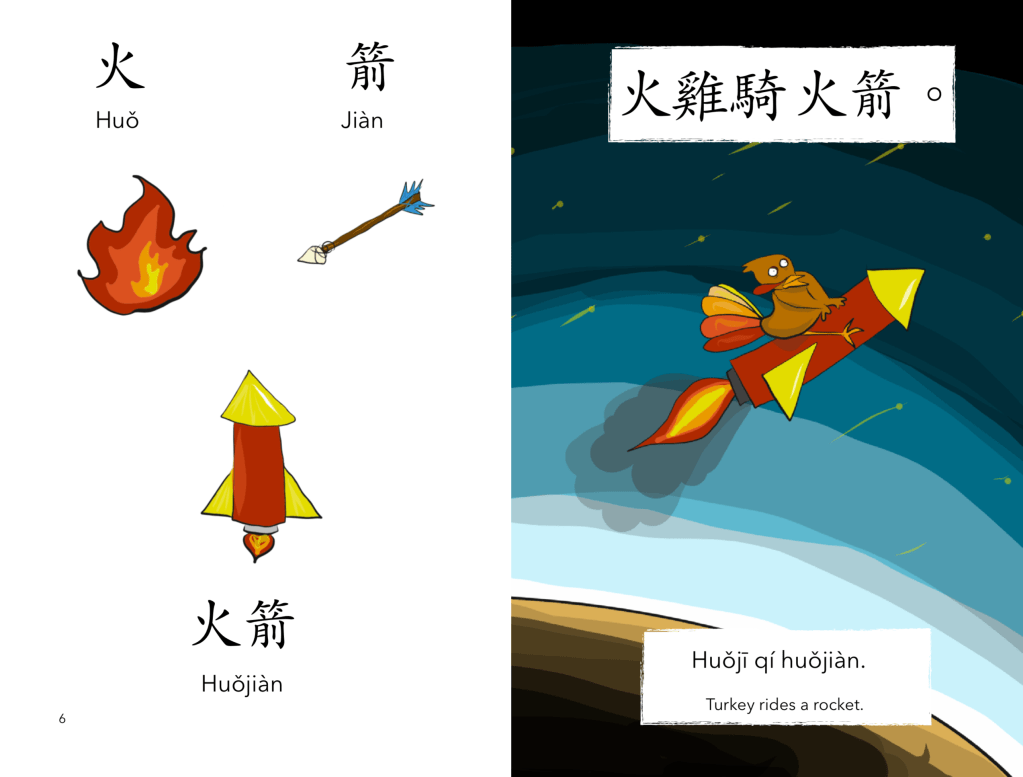
Next month is the release of another easy-reader: Turkey Rides a Rocket. Think of it as the Chinese “Hop on Pop,” where two words are introduced and then put into context–usually in a humorous way. It is fun, fresh, and there is simply nothing out there like it. I’m excited to tell you more about it next time.
Thank you to all of you and your love of learning. Never give up! You got this.
When I first learned Chinese in an academic setting, I had classmates who struggled with Chinese because they glazed over the foundation of the entire language: tones. They had a Western background, and as they struggled to hear the different sounds they would say, “I’m just tone-deaf, that must be the reason I can’t get it.” I thought to myself, “training can overcome tone-deafness – just look at the billions of people in China and Taiwan who can do it!”
Fast forward many years to teaching my kids Chinese. For the most part, they get tones, probably because of brain plasticky. But for words that are spelled the same but are read with different tones, they struggled and needed something more visual to help them along. These two Guess the Tone Game videos are helpful because they directly compare two words that are almost alike but have different meanings. Plus the video has a game show feel where kids can applaud their own efforts.
Whether you are training out the tone-deaf, ironing out some tonal obstacles, or reviewing for fun, these videos are for to enjoy.
This is just a very basic review of tones. It can get more complicated when tones are combined in series and a 4th tone may change to 2nd tone, or a 4th tone could be dropped to a “no tone.” Would it help to make a Guess the Tone game about this? Let me know! And as always, happy learning!
It has been a while since I’ve been to my ancestral graves, but the feeling there is nothing short of mystical. Mounds and mounds of gravesites built almost on top of each other. Ancient crumbling stone. Weeds and nature creeping forward to reclaim the land.
Cleaning the gravesite is an arduous task. When my brother and brother-in-law went to do it, they were gone half the day and came back sweaty and cranky. “We couldn’t even find the headstone for awhile. We had to put the weeds in a huge pile and burn it!” they told me. I wondered why we went to all that effort to honor our ancestors in this way. Couldn’t we just stay at home and burn incense to them?
My mother told me one time that it is a matter of pride. She said that clean and swept gravesites meant the family of the deceased is doing well and still honors their ancestor. People will look at an unswept grave and say, “Look! Their descendants are not responsible and do not care.” So there is some judgement that goes on–or societal pressure. It is such a big deal that my family returns every seven years (we are on a rotation schedule with other family members) to do this ritual even though we all live in America now and are not religious in an ancestor-worship way.
Whether you are able to go to your ancestor’s graves or do a small ritual in their honor, I think the important thing is to just remember them. Tell stories about them, let them live in your minds and hearts.
Here is a video that gives some ideas of ways you can involve your kids in a small tomb sweeping day ritual. You can tell my kids are totally casual and maybe a little sacrilegious, but you have to start somewhere! From my home to yours, have a meaningful 清明節!
“I hate Chinese!” my 5-year old daughter yelled at me, “I don’t understand it.” When she was younger (the cheery age of 2 or 3) she followed along with whatever Chinese lesson I concocted–not caring if she could pronounce the words perfectly or that she could understand everything. She was just happy I was focusing my attention on her. Now, at the tumultuous age of 5, she resisted things that required effort. With fire in her eyes, she reminded me of myself when I was younger and demanded that my parents, “stop speaking THAT language!” It was history repeating itself, and I was afraid my child would grow up like me–ignorant of a language and culture that was apart of her.
I am the little girl with her tongue sticking out. I was very resistant to learning Chinese.
One night, while staring at the ceiling and pondering existential questions (or something), I decided I would have to not teach her harder, but teach her smarter. I thought of how different of an experience it was to potty train my son than my daughter. My daughter needed a schedule, stickers, distant big rewards. When I tried the same program with my son, he failed completely. I ended up needing to potty train him using games and instant rewards. It worked better with his restless, on-the-go personality. So it was only when I catered to the child and his/her situation, I became an effective teacher.
I applied this idea to teaching my fiery 5-year old. When she was little, she loved cut-and-paste worksheets, so I found cut-and-paste worksheets in Chinese for to do. It worked then, but what about now? I took a good long look at her and her passions. I realized she was really into independence and every time she returned home from a book fair she bought Easy-reader books because she could disappear into her room and read them herself. Pretty soon, she had a good collection of 9” x 6” Easy-reader books–it was her pride and joy and she lined them up neatly on her bookshelf. I immediately got the idea to make a Chinese Easy-reader book for her, but I would model it after the many books she already loved: They would have several short stories in one book. The would contain stories that were very simple, or versions of classic tales she was already familiar with. They would have colorful illustrations and games/review exercises at the back of each story. But most of all, they would be simple enough that she could attempt to read them BY HERSELF!
And with that plan, I went ahead and created two Chinese Easy Reader books. Was it effective? That is the important question. Did her passion that manifested itself in English translate over to Chinese?
I have to relate the experience I had when I first showed her the final copy of the book. The covers were bright and glossy, the illustrations I had slaved over were more engaging in person, the new book smell flew out of the crisp pages. I placed it in her hand and encouraged her to repeat after me to read the first page. Suddenly her eyes glazed over and her lips tightened. “Come on,” I urged her, “say dà!” She turned and walked away.
I was stoney silent the rest of the night. I thought my daughter was being cruel, that if she wanted to drive a knife into her mother’s heart, there was no better way. I thought of giving up, never speaking Chinese to her again. But then I thought of myself as a young girl, how many times I had angrily refused to learn Chinese from my parents, but at one point I hit a turning point. I transformed from a recalcitrant girl to a regretful girl. If history repeats itself, so will her regret come one day.
I let it sit for a few days. We didn’t speak Chinese. I didn’t touch the new books I had made for her. We were at an uneasy truce.
Then one night, while we were choosing books to read before bed, I asked her, “can we read the book I made for you?” She nodded. So there we sat, daughter in mother’s lap, and I read to her a simple story in Chinese. I asked her to repeat a few characters, and she did. Then we played the review game together–which she did with more gusto. Then we put it away, and read something else.
It was a small victory that meant so much to me. Instead of being more authoritative in my Chinese teaching, it became more natural when it was eased into our nightly routine. I tried the same thing the next night and the next night with similar success. She became more and more willing to read with me because she knew what to expect (just a short 5-minute moment in Chinese). Could she read a complete story by herself? Not yet, but I could feel her confidence growing when she tried to read a few characters by herself.
Now, everyone’s relationship with their kids are different. Some have kids that readily take up a second language. Maybe mine inherited my stubbornness. However, I think the principle in teaching your child Chinese can be the same. You need to make it fun for them and the only way to do that is to follow their passions. Do what they like and do it in Chinese. That way, when they get to that turning point where they actively want to learn Chinese by themselves, they will have fond memories of learning it with their parents.
Happy Learning!
Love, Enge
My daughter is in the middle, five and full of fire. But I love her.











 Tiny Chinese Homeschool